
 thekesleygroup_udhc17
Why Strong Nonprofits Still Get Stuck
Over the past several years, I’ve worked with nonprofit boards, executive leaders, and community organizations of very different sizes. While every organization is unique, I’ve been surprised by how often the underlying organizational patterns are remarkably similar.
I’ve never walked into a struggling nonprofit because people didn’t care enough.
They cared deeply.
They worked long hours.
They believed in the mission.
Many were sacrificing financially to keep the organization moving.
Yet, despite all that commitment, something still wasn’t working.
The mission wasn’t broken.
The organizational systems supporting the mission were.
Press enter or click to view image in full size
The Pattern I Keep Seeing
In one boardroom, I watched directors spend nearly an hour reviewing reports. The financials were sound. Committee chairs gave thoughtful updates. Every item on the agenda was approved. Yet when someone asked how those discussions connected to the organization’s strategic priorities adopted months earlier, the room fell quiet.
In another, I watched an executive director gradually assuming responsible operations, strategy, fundraising, and even governance. This wasn’t planned. It just evolved over time. And no Board member wanted to question, “is this ok?” No one wanted to be the person who said, “Wait, I think that’s too much responsibility for one person to carry.” And then one day, that Executive Director walked out. Burned out. And the Board didn’t see it coming. When things change by inches, no one notices until one day someone asks, “how did this happen?”
In a third, everyone agreed on the mission, but nobody could clearly explain how decisions were made. Who had the authority for decision making? Who could approve new initiatives? Did it have to come to the Board? Could the Executive Director just run with it and update the Board later? It wasn’t clear.
Different organizations.
Different symptoms.
At first glance, each organization appeared to have a different problem. One needed a stronger board. Another needed additional staff. Another needed better planning. But as I looked deeper, the pattern was remarkably consistent. The issue wasn’t the mission. It wasn’t commitment. It was that governance, leadership, strategy, and operations were no longer reinforcing one another.
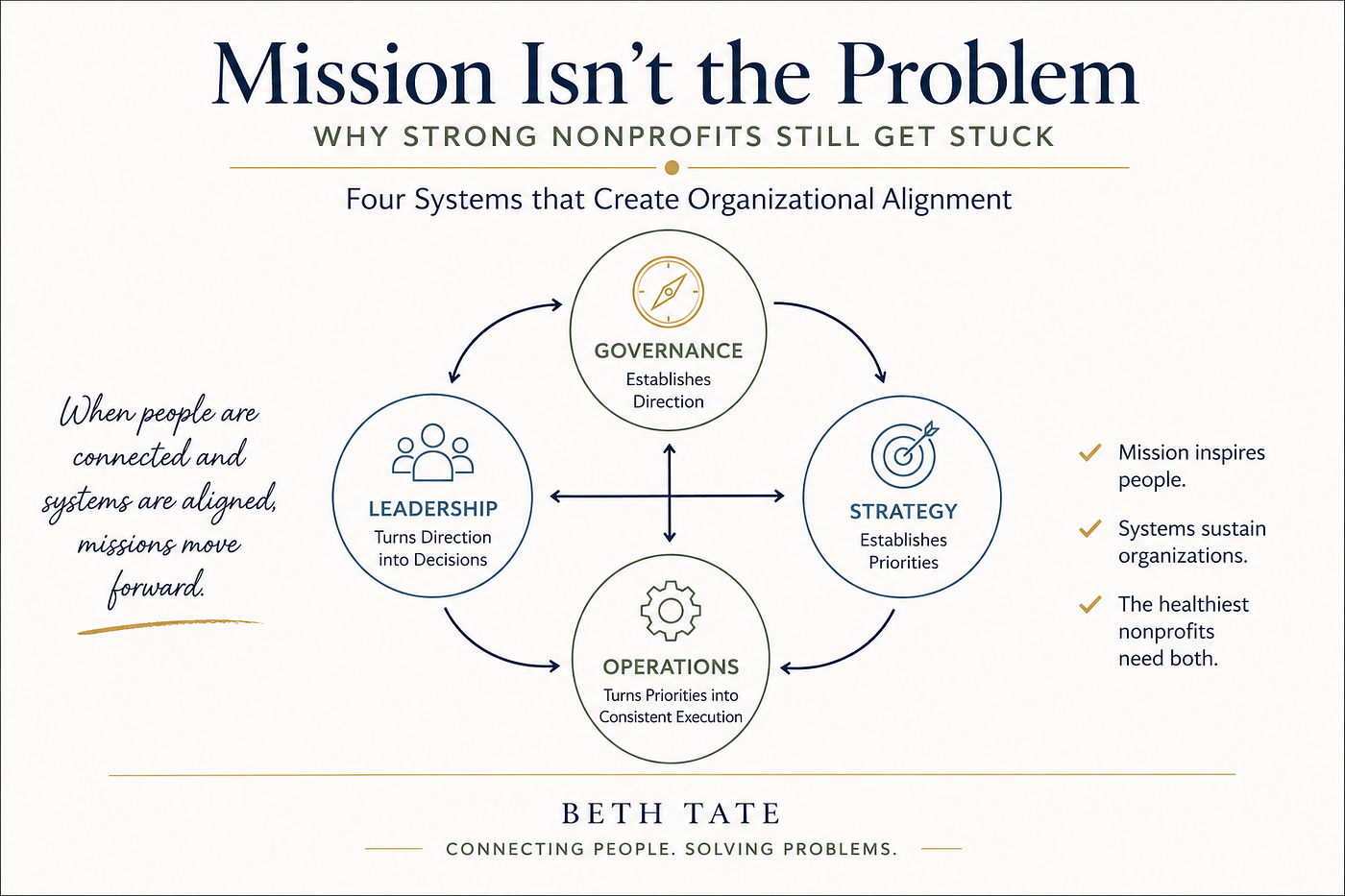
Four Systems that Create Organizational Alignment
Governance
The board’s role is stewardship and strategic oversight.
Not operations.
Not staff management.
Not day-to-day execution.
Governance establishes direction.
Leadership
The executive director’s role is organizational leadership.
Leadership turns that direction into decisions.
Leadership only works when authority and accountability are clearly defined.
Strategy
Strategy should answer:
- Where are we going?
- What are we saying no to?
- How will we measure success?
Many organizations have plans.
Fewer have active strategy.
Operations
Operations make those priorities happen consistently.
Operations translate strategy into repeatable execution.
This is where processes, communication, staffing, and accountability live.
When one of those systems weakens, the others begin compensating. And eventually, the organization feels the strain.
Drift Happens Quietly
Organizations rarely become dysfunctional overnight.
They drift.
Nobody decides to blur governance and operations.
Nobody announces that strategy will no longer guide decisions.
Nobody intends for the Executive Director to become responsible for everything.
The organization adapts.
Then adapts again.
Then one day everyone feels overwhelmed, but no one can identify exactly when that changed.
That’s how misalignment develops.
Misalignment rarely arrives as a crisis.
It arrives as accommodation.
What Misalignment Looks Like
If you’re seeing
· Decisions routinely delayed
· Board meetings that feel repetitive
· Staff constantly waiting for approval
· Strategic plans that aren’t referenced
· Leaders exhausted
· High turnover
· Constant urgency
None of these are the problem.
They’re evidence that the underlying systems have fallen out of alignment.
Why More Effort Doesn’t Solve It
Most nonprofit leaders don’t respond to friction by slowing down.
They respond by working harder.
More meetings.
More committees.
More reporting.
More urgency.
More effort.
But effort is not the same thing as alignment.
Organizations don’t become healthier simply because good people work longer hours.
Questions Every Nonprofit Board Should Ask of Themselves
- Where do decisions routinely get stuck? What is preventing us from moving past the questions and making a decision?
- What decisions belong to the board?
- What decisions belong to leadership?
- Is our strategy still aligned with today’s reality?
- Are our operations supporting or hindering execution?
- Where is friction showing up repeatedly?
Conclusion
Boards often ask how to accomplish more.
I think the better question is whether the organization is designed to accomplish what it already intends to do.
The healthiest nonprofit organizations are not necessarily the ones with the largest budgets, the most programs, or the most visibility.
They are the organizations where governance, leadership, strategy, and operations reinforce one another.
When those systems align, momentum follows.
Mission inspires people.
Systems sustain organizations.
The healthiest nonprofits need both.